
Policy and Basic Approach
In our Articles of Incorporation, we designate our employees as one of the Company’s principal stakeholders to realize our Corporate Concept (hhc), and enhance the value of our “human talent” by ensuring stable employment, respecting human rights and diversity, providing full opportunities for growth in support of self-fulfillment, and creating an employee-friendly environment.
We aim to effectively achieve social good by placing hhc and compliance as our core value for human resources, aligning our vision with what employees want to accomplish, and by providing an environment and programs that enable every employee to carry out their daily work with a sense of fulfillment and job satisfaction based on a strong sense of empathy with our corporate concept, and at the same time, support the growth and self-realization of the employees themselves.
Targets, Issues and Actions
We are focusing on strengthening organizational management, both in terms of systems and operations, in order to conduct the appropriate placement of human talent that supports the effective achievement of social good, treating them fairly, improving work engagement, and fostering a sound organizational climate.
In order to foster a climate that accepts and acknowledges differences in opinions and ideas among employees and promotes dialogue based on diverse values within the organization, we continue to work on simplifying the design of the organization and hierarchy, data-driven visualization of the characteristics and activities of the organization and its members, and developing and enhancing training programs that contribute to the improvement of management skills.
In addition, we support employee self-realization, along with careful management of goals, through fair screening of individual employees’ willingness and attitude toward work, performance and contribution to the company in light of the standards required for each role, as well as by conducting career reviews and providing opportunities to realize their potential.
Structures and Systems
To support each employee in delivering results and achieving continuous growth, the Company conducts an annual performance evaluation. The evaluation is based on two perspectives: a “Goal Achievement Evaluation,” which assesses the extent to which performance objectives set at the beginning of the fiscal year have been achieved, and a “Behavioral Evaluation,” which assesses the behaviors demonstrated in the course of performing one’s duties.
At the beginning of each fiscal year, the organization’s vision and objectives are shared, after which employees meet with their supervisors to set annual performance objectives, achievement criteria, and quarterly action plans. Employees also identify the behaviors they should prioritize for further development from among the six behavioral elements expected of all employees and reflect specific actions in their plans for achieving their objectives.
During the course of the fiscal year, quarterly reviews are conducted to discuss progress against objectives and action plans, as well as the behaviors demonstrated. Objectives and action plans are reviewed and adjusted flexibly in response to changes in the business environment or individual roles. In addition, quarterly one-on-one meetings provide ongoing follow-up on progress, support in resolving issues, and discussions regarding career development and personal growth. Through this agile and continuous dialogue, the Company supports each employee's proactive efforts in taking on challenges and pursuing continuous growth.
At the end of the fiscal year, employees conduct a self-review and participate in a progress review with their supervisors. Supervisors then evaluate both the achievement of objectives and the behaviors demonstrated based on the six behavioral elements. These behaviors are assessed in accordance with evaluation criteria established for each role and grade. The results are used for employee development and management purposes and are also taken into consideration in decisions regarding promotion and demotion.
Final evaluations are determined through a multi-stage process comprising the initial evaluation, reviews by branch and divisional human resources committees, an assessment by the CHRO, and final approval by the CEO. Company-wide calibration is conducted at multiple stages to enhance the fairness, objectivity, and acceptance of evaluations across organizational boundaries. Supervisors provide employees with feedback on their final evaluations, which is then used to support objective setting and capability development for the following fiscal year. Through this evaluation process, the Company supports employees’ continuous growth and strengthens organizational capabilities toward the realization of its corporate concept.
In Japan, the Company also provides all employees with the Professional Development Review system, which enables each employee to envision what they want to become in the future, understand their own strengths, weaknesses, and values, and then translate these into action plans to support self-actualization. In addition, the Company provides a system through which each employee’s wishes, ideas, and opinions are reflected in personnel transfers, Company policies, and other measures.
Initiatives
1)Engagement survey
To maximize the value of human resources, we have introduced an annual global engagement survey since fiscal 2021, surveying and indexing the awareness of employees awareness of employees on the company, work and organizational culture in all global companies of the Group, and utilized the results for analysis and action.
In the 5th survey in fiscal 2025, the primary endpoint “Sustainable Engagement” maintained a score of 85 points, on par with the global pharmaceutical company benchmark. We also scored organizational culture across 15 other categories, with 11 categories showing increases in scores from the previous year. Scores for categories in which we are strong remained at high levels. These encompassed hhc concept-based management, target objectives, social responsibility, and integrity & ethics. 10 categories registered scores that were significantly higher than the global pharmaceutical company benchmarks, and no categories were significantly lower. The results suggest continued positive progress in employee perceptions of our organizational culture.
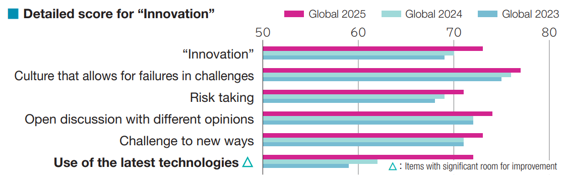
“Innovation,” one of the challenging categories, improved markedly, by three points year-on-year, reaching a total of 73 points. Within this category, the question with the greatest improvement was “Use of the latest technologies,” which rose 10 points from the previous year. Each of the other four questions linked to fostering a culture that facilitates innovation improved by one or two points year-on-year. Nevertheless, this category overall still has potential for more improvement.
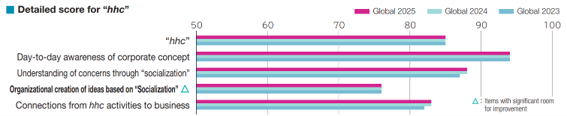
Regarding understanding and practice of our corporate concept, “hhc,” scores for each item remained at a high level, as in previous years. On the other hand, “Organizational creation of ideas based on socialization” remained at 76 points, showing limited growth and leaving significant room for improvement. A culture of innovation is continuing to be nurtured, but this needs to be translated into the realization of hhc.
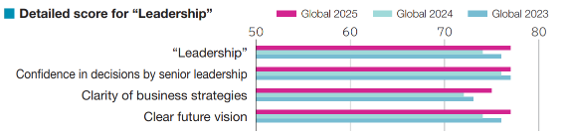
Another challenge category, “Leadership,” which had been on a downward trend for three consecutive years, has improved by three points year-on-year. This category reflects the score for employees’ sense of satisfaction with the company’s vision, strategies, and plans, and addressing information asymmetry between the company and employees regarding management information, as well as strengthening two-way dialogue, has been designated as an important common global action. In each region and function, efforts are being made to improve dialogue and information dissemination, and as in the previous year, a marked score improvement was seen in Japan. We will continue to communicate with employees about updates to corporate strategy.
2)Initiatives Toward Enhancement of Organizational Strength
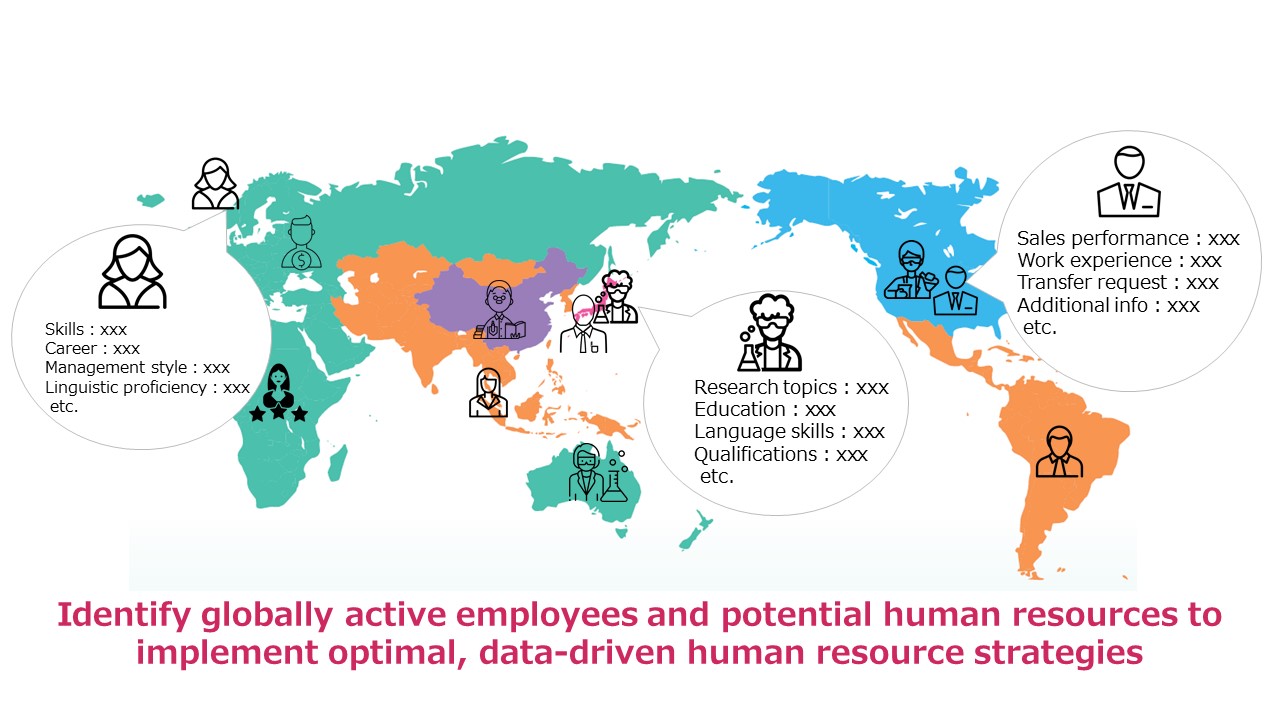
In order to visualize important positions and talents in the company globally, we identify important positions and formulate a succession plans with talent requirements and skill maps. At the same time, we have created development plans based on the experience and knowledge of successor candidates and are striving to produce global leaders systematically and sustainably. For positions that cannot be filled with the existing talents, we hire personnel and reassign personnel across regions to strengthen our global talent management. Regarding next-generation talents who have been recognized through these activities, corporate human resource managers conduct individual interviews on-site, and work to create a talent map that includes not only the status of duties but also future career plans of candidates.
Global Talent Mapping
3)Job Challenge (Internal Job Posting System)
In Japan, we promote the “Job Challenge (Internal Job Posting System),” which allows employees to voluntarily apply for internal transfers to new jobs or organizations. Through this system, we promote talent allocation based on each employee’s career aspirations while supporting autonomous career development and fostering a culture of career ownership. Since the system was introduced in 2016, a total of 78 employees have used it to transfer to new positions through FY2026 and are now active in new fields.
4) 360° Leadership Survey
Starting in FY2025, the Company introduced a 360° Leadership Survey targeting all organizational leaders, establishing a system that provides feedback from supervisors, team members, and peers from a 360-degree perspective. Under the theme of “Positive & Casual,” the program is designed to be separate from personnel evaluations, aiming instead to facilitate dialogue for smoother organizational management and encourage behavioral change that supports the growth of organizational leaders themselves.
In FY2025, the first year of the program, the survey was conducted for approximately half of the organizational leaders (around 200 individuals), followed by a Management Dojo to support reflection and the development of action plans for behavioral change. In FY2026, the same survey and Management Dojo will be conducted for the remaining approximately half (around 200 organizational leaders).
Data
| Scope of data | Unit | Period | FY2022 | FY2023 | FY2024 | FY2025 | ||
|---|---|---|---|---|---|---|---|---|
|
Penetration of corporate concept hhc*2 |
Global | % | Annually | 96% | 96% | 95% | 95% | |
|
Global Engagement Survey Score: |
Global | Point (%) |
Annually | 85 (81%) |
85 (83%) |
85 (90%) |
85 (94%) |
*1 Our DEI initiatives, KPIs, and objectives are designed to reflect and respect the diverse legal and cultural landscapes in which we operate globally. In some regions, such as the United States, local laws may not permit the implementation of certain DEI measures. In those cases, we do not implement those measures but remain fully committed to fostering a culture of belonging in ways that align with applicable laws.
*2 Response rate of Favorable or higher for the question "Support for corporate concept" in Eisai Global Engagement Survey.