
Compliance Promotion and Fostering Integrity
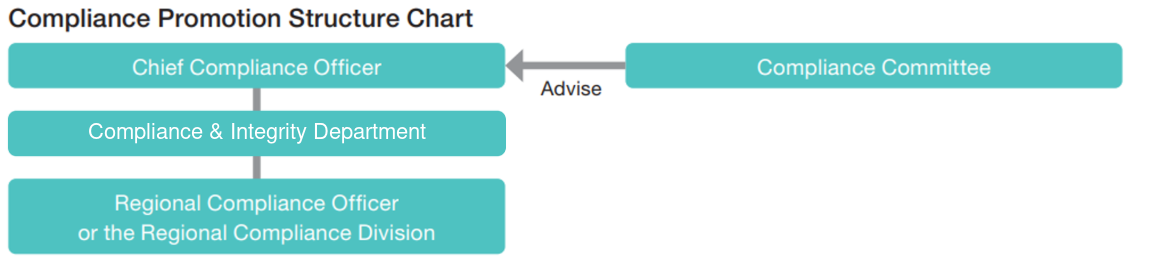
Eisai promotes its compliance program that consists of delivering the message of top management, developing the Code of Conduct and other relevant rules, conducting educational activities, establishing a training system as well as providing consultation services by defining compliance as “the observance of the highest legal and ethical standards” and positioning it at the core of management activities. Based on a lesson from the international vitamin E cartel, Eisai started to promote full-fledged compliance in FY 2000. These compliance promotion programs periodically undergo objective reviews by Compliance Committee that consists of outside experts such as lawyers and consultants from Japan and overseas.
1. Establishment of Code of Conduct and Other Relevant Rules and Conducting Educational Activities to Foster Compliance Awareness
Eisai has been publishing Compliance Handbook, which outlines Eisai Network Companies (ENW) Charter of Business Conduct and the Code of Conduct, to cultivate the compliance awareness. For all officers and employees in all Eisai network companies, this handbook is available in 16 languages.
All officers and employees not only participate in training to understand contents described in Compliance Handbook, but also swear to comply with it every year.
In addition, with the aim of raising compliance awareness and preventing incidents from happening, we continuously conduct various training programs utilizing different formats, such as compliance workshops for corporate officers, e-learning trainings for all corporate officers and employees, and workshop training materials for each department. These education and training programs continuously cover topics related to business ethics and compliance, including anti-bribery and anti-corruption, as well as information on how to use the consultation and reporting systems and on whistleblower protection, thereby enhancing compliance awareness among all corporate officers and employees.
2. Compliance Counter and Speak-Up (Whistleblowing, Reporting and Consultation Systems)
Eisai operates whistleblowing, reporting and consultation mechanisms globally to provide an environment in which corporate officers, employees and business partners can feel safe to speak up, seek advice and report concerns. The Compliance & Integrity Department and the compliance functions in each region work together to operate these consultation and reporting mechanisms and respond to concerns and reports. In Japan, the United States, Europe, China, and Asia, Eisai has established consultation and reporting channels in accordance with applicable laws and local business environments, as well as multiple global and regional channels, including the hhc Global Helpline, which is operated by an independent external third party. Eisai also provides a variety of consultation and reporting channels so that users can select an appropriate channel depending on their circumstances, including mechanisms that allow anonymous consultation and reporting. In addition, Eisai provides an external consultation service operated by an ombudsperson independent of the company, where employees can seek neutral advice on workplace- and work-related concerns and issues, as part of its efforts to foster a workplace environment in which employees feel comfortable speaking up.
- Internal Compliance Counter
- Consultation and reporting channel provided by independent external legal counsel
- hhc Global Helpline (global reporting channel), operated by an independent external third party
- External consultation service (ombudsperson)
The Compliance Counter accepts not only consultations and reports concerning violations of laws, regulations, and internal rules, but also a wide range of questions and concerns about compliance arising in day-to-day business activities.
Anonymity and Whistleblower Protection
Eisai accepts anonymous consultations and reports in accordance with applicable laws and regulations in each country and region. Information concerning consultations and reports, as well as information concerning persons who raise concerns, is strictly managed and is not disclosed except to the extent necessary for an investigation. Eisai does not tolerate any form of retaliation against persons who seek advice or report concerns in good faith and is committed to protecting whistleblowers.
Investigation and Remediation Process
Compliance matters raised through consultation or reporting channels are handled in a manner that ensures fairness, objectivity and confidentiality. Investigations are conducted in accordance with the following process:
Consultation / Report
↓
Assessment of the need for and method of investigation
↓(if an investigation is deemed necessary)
Investigation and fact-finding
↓
Determination of facts
↓
Determination of compliance violation
↓
Reporting to relevant functions
↓
Implementation of training and other measures as necessary; disciplinary action by relevant functions
↓
Prevention of recurrence and continuous improvement
Investigations are conducted fairly and promptly, taking into account the nature and risks of each matter, and appropriate action is taken in coordination with external experts where necessary.
Education and Training
Eisai continuously provides compliance training and e-learning for all corporate officers and employees. Education on the appropriate use of consultation and reporting systems covers the following:
-
- When to seek consultation or report compliance concerns
- How to use consultation and reporting channels in each country and region
- Anonymous consultation and reporting
- Whistleblower protection and prohibition of retaliation
- Processes for handling reports
Through these initiatives, Eisai works to foster a Speak-Up culture and enhance compliance awareness.
3. Prevention of Bribery and Corruption
Based on its strong determination to undertake honest business activities, Eisai established the “ENW Anti-Bribery and Anti-Corruption Policy” in January 2012 and revised it in April 2026 as the Global Anti-Bribery and Anti-Corruption Policy. The Policy sets forth global fundamental principles and minimum standards for the prevention of bribery and corruption and applies to all corporate officers and employees of Eisai Network Companies (ENW), as well as business partners involved in Eisai’s business activities.
As one concrete initiative, Eisai conducts ABAC (Anti-Bribery and Anti-Corruption) due diligence based on a risk-based approach for companies with which it plans to enter into new business relationships. As part of the due diligence process, Eisai uses a background screening system and requires prospective business partners to respond to a globally common questionnaire concerning bribery and corruption risks, thereby identifying and assessing compliance risks associated with new business partners before commencing business relationships. Where risks are identified as a result of the assessment, Eisai takes appropriate action, including additional investigations and risk mitigation measures as necessary, to reduce risks associated with new business relationships. These initiatives are implemented in the Americas, including Mexico, Brazil and Canada; Europe, including Russia and Eastern Europe; China; and Asian countries, including India, thereby strengthening third-party risk management globally.
In addition, at certain overseas ENW companies, particularly those in higher-risk countries and regions, Eisai is developing mechanisms that use the monitoring of accounting and financial data to identify early signs of potential fraud, thereby strengthening its control framework for the prevention and early detection of fraud.
Eisai works to prevent bribery and corruption based on the following fundamental principles:
- Zero tolerance for bribery and corruption
- Prohibition of facilitation payments
- Compliance with applicable anti-bribery laws and regulations in each country and region
- Conducting fair and transparent business activities
Gifts and Hospitality
Gifts, hospitality and other business courtesies must be provided or received in accordance with applicable laws and regulations and internal rules in each country and region, and must be subject to the applicable approval procedures. Providing or receiving such items for the purpose of obtaining an improper advantage or improperly influencing business decisions is prohibited.
Political Contributions
Political contributions are appropriately managed in accordance with applicable laws and regulations and internal rules in each country and region. Political contributions made for the purpose of obtaining an improper advantage or improperly influencing business decisions are prohibited.
Donations and Sponsorships
Donations and sponsorships are subject to review and approval procedures in accordance with internal rules. Donations and sponsorships made for the purpose of obtaining an improper advantage or improperly influencing business decisions are prohibited.
Due Diligence on Business Partners
Eisai conducts bribery and corruption risk assessments and due diligence on business partners, including agents, distributors, suppliers and consultants. When entering into new business relationships, Eisai uses a globally common ABAC due diligence system to conduct risk-based assessments and reduce bribery and corruption risks.
Education and Training
Eisai continuously provides compliance training and e-learning for all corporate officers and employees. The training covers topics including the Global Anti-Bribery and Anti-Corruption Policy, prevention of bribery and corruption, gifts and entertainment, political contributions, appropriate relationships with business partners, consultation and reporting systems (Speak-Up), and whistleblower protection, with the aim of enhancing compliance awareness and preventing misconduct.
Response to Violations
Concerns regarding bribery and corruption, as well as suspected violations of laws, regulations or internal rules, may be raised through the Compliance Counter and global reporting channels. Reported matters are handled in a manner that ensures fairness, objectivity and confidentiality. Initial assessments, investigations, corrective actions and, where necessary, disciplinary measures are undertaken, with external experts engaged as appropriate. Retaliation against persons who seek advice or report concerns in good faith is prohibited.
4. Compliance-based promotion
Eisai conducts ethical promotion globally in accordance with compliance requirements. We disclose information on payments to medical institutions and patient groups, in accordance with the Japan Pharmaceutical Manufacturers Association (JPMA) guidelines, and the regulations and guidelines of each country in order to have broad societal understanding that our corporate activities are undertaken based on the highest ethics.
5. Fostering a Culture of Integrity
Beginning in fiscal 2026, the Compliance Promotion Department was renamed the Compliance & Integrity Department. In addition to appropriately addressing compliance issues that arise, the department will place greater emphasis on preventing misconduct and recurrence and will work to foster a culture of integrity throughout the organization.
■Setting Forth a Code of Conduct in the Compliance Handbook
Eisai has set forth a code of conduct in the Compliance Handbook that is distributed to all employees to ensure compliance-based promotion. The following is an excerpt from the handbook.
-
Eisai markets and promotes its pharmaceutical products worldwide. We provide accurate and balanced scientific information, and promote our products only for the uses for which they have been approved by the applicable regulatory authorities.
-
“Promotion” means any activity undertaken, organized, or sponsored by a pharmaceutical company which is directed at Healthcare Providers (HCPs) to promote the prescription, recommendation, supply, administration, or consumption of its pharmaceutical products through all methods of communication, including the Internet.
-
When engaging in promotional activities with HCPs, we are expected to be familiar with local laws and regulations for such engagements in our home country.
- Promotion in a manner not consistent with the approved label is prohibited and promotion of drugs prior to approval is also prohibited. All promotional materials must be reviewed and approved in accordance with local processes and may be used only for the approved purpose.
■Formulation of Eisai Co., Ltd. Code of Practice
In March 2012, the International Federation of Pharmaceutical Manufacturers & Associations (IFPMA) announced the “IFPMA Code of Practice” (“IFPMA Code”) as a code covering not only marketing activities but also interactions with healthcare professionals, medical institutions and patient organizations, as well as the promotion of medicines. In line with the intent of the IFPMA Code, the “JPMA Code of Practice” was established and implemented by the JPMA. Then Eisai, as a member of JPMA, established the “Eisai Co., Ltd. Code of Practice” in line with the aforementioned Code. All the executives and employees at Eisai engage in corporate activities with the aim of earning the trust from society by ensuring high level of transparency, ethics and corporate accountability in corporate activities involving researchers, healthcare professionals and patient organizations.
■Compliance Test
This is a set of questions that Eisai Group officers and employees ask themselves when they are unsure of a decision.
1. Could you openly tell your family what you have done?
2. Do you think it’s acceptable to be non-compliant as long as you are not found out?
3. How would it feel to read a report of your activities in the news or on social media?
Promoting Risk Management
1. Risk Management System
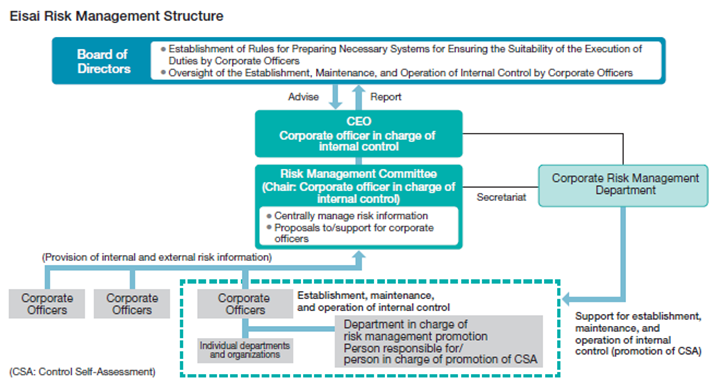
Eisai’s Board of Directors has established the "Rules on the Development of Systems Necessary to Ensure the Proper Execution of Duties by Corporate Officers etc." in accordance with the Companies Act. These Rules require all corporate officers to identify risks within their areas of responsibility and to establish, develop, and implement appropriate internal control systems.
The Representative Corporate Officer & CEO appoints a Corporate Officer responsible for Internal Control, who leads and promotes the development, maintenance, and effective operation of internal controls across the Group.
The Corporate Risk Management Department works collaboratively with Regional Risk Management Promoters to support the development, maintenance, and effective operation of internal controls across the Group.
To ensure effective risk management across the organization, Eisai conducts an annual global CSA (Control Self-Assessment) to identify and assess risks throughout the company. Out of the risks identified through this CSA, the Risk Management Committee, etc., discusses those risks that are shared Company-wide, and strives to prevent those risks from materializing.
2. Eisai Network (ENW) Internal Control Policy
The Corporate Officer responsible for Internal Control has established a globally standardized “ENW Internal Control Policy”, and promotes the establishment, development, and implementation of internal controls across the Group.
Eisai Network (ENW) Internal Control Policy
Under the human health care (hhc) concept, we aim to effectively achieve social good in the form of relieving anxiety over health and reducing health disparities.
In order for us to achieve this goal, it is essential to establish internal controls, and continuously develop, implement, and improve them in compliance with laws and the Articles of Incorporation. For this reason, we hereby establish our internal control policy based on the "Corporate Governance Principles" and "Rules on the Development of Systems Necessary to Ensure the Proper Execution of Duties by Corporate Officers etc." established by the Board of Directors.
Therefore, we, as the officers, managers, and employees of ENW Entity, will commit ourselves to establishing internal controls and to their continuous development, implementation, and improvement in accordance with the following principles:
-
1.We will identify and assess risks that may impact our business activities and operational processes, and fraud risks that may affect the corporate value, and take countermeasures.
-
2.We will develop a control environment to include elements such as a business code of conduct, decision-making procedures for important matters, committees, job descriptions and the organizational culture to ensure the necessary ownership and treatment of risks.
-
3.To mitigate and manage risks, we will develop and implement control mechanisms to include policies, internal rules, operating processes, systems, training, etc.
-
4.We will develop and implement a structure for the appropriate storage and management of information related to business activities, appropriately recording and retaining the information, as well as communicating the information in a responsible and timely manner.
-
5.We will develop and implement a system that shares and/or reports information with the relevant Eisai companies and organizations regarding the status of internal control development and implementation.
-
6.We will enhance the effectiveness of our internal controls through regular self-assessments and third-party reviews.
February 16, 2026
Shin Kato
Vice President, Internal Control
Eisai Co., Ltd.
3. CSA (Control Self-Assessment)
CSA (Control Self-Assessment) is implemented as a tool to ensure effective risk management across the Group. CSA is a method for self-assessing risks and the status of their controls, and for using the results to lead to improvements. Eisai conducts CSA for all Corporate Officers. Eisai identifies critical risks across the company through identifying and assessing risks within their areas of responsibility by all Corporate Officers, and enhances the effectiveness of its risk management by following up on the status of responses to those risks.
Risk assessments by Corporate Officers are conducted twice a year—at the beginning of the fiscal year (prior to implementing countermeasures) and at the end of the fiscal year (after implementation)—to verify the effectiveness of these measures. The results are reported to the Board of Directors and the Audit Committee.
4. Risk Assessment Process
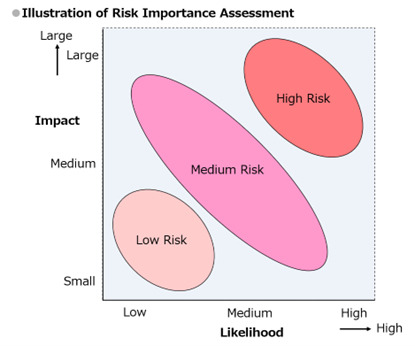
In the aforementioned CSA, the importance of risks identified by each Corporate Officer is assessed based on their impact and likelihood of occurrence of the risks, taking into account the status of the development and implementation of internal controls.
5. The Risk Management Committee
The Risk Management Committee holds regular meetings (in principle, five times per year), either in Japan or globally depending on the matters to be considered), with the Corporate Officer responsible for Internal Control serving as the chair and receiving advice from the Board of Directors, to obtain comprehensive view of company-wide risks.
Based on this, the Committee conducts risk assessments, selects important risks from an enterprise-wide perspective, and supports risk owners in establishing, developing, implementing, and improving internal controls related to those risks.
In addition, to identify new risks and respond to them quickly and efficiently, the Committee reviews potential risks by referring to external corporate scandals and other incidents, and strives to prevent those risks from materializing.
● Overview of the methods to determine important risks to be followed by the Risk Management Committee
1) The Secretariat of the Risk Management Committee (the “Secretariat”) comprehensively assesses all important risks identified by Corporate Officers through CSA, Materiality, Risk Factors, and selects candidates for important risks, taking into account internal controls spanning multiple Corporate Officers and departments.
2) In determining candidates for important risks, the Secretariat considers the status of development and implementation of internal controls, the progress of countermeasures, the medium- to long-term impact, and the scope of Corporate Officers and departments involved.
3) Risks identified as candidates for important risks are assessed from a comprehensive perspective, including the use of risk maps, to determine the final set of important risks.
4) Notwithstanding the above processes, if concerns arise regarding new risks in the internal or external environment or in the advancement of business, the Committee will consider such risks based on the chairperson's instructions or suggestions from Committee members.
6. Training and related activities
The ENW Internal Control Policy states, 3. To mitigate and manage risks, we will develop and implement control mechanisms to include policies, internal rules, operating processes, systems, training, etc.” Based on this policy, we have developed and disseminated global guidelines for internal control and risk management.
We regularly conduct training on internal control and risk management through e-learning for executives and employees, as well as programs for newly appointed organizational leaders.
In 2026, we conducted training for newly appointed organizational leaders in April, training for overseas risk management promoters in May, and e-learning in June.
7. Audits related to risk management promotion activities, etc.
As part of confirming the implementation status of the "Rules on the Development of Systems Necessary to Ensure the Proper Execution of Duties by Corporate Officers etc." established by the Board of Directors, the Corporate Officer in charge of internal control reports the annual policy and results of risk management promotion activities to the Audit Committee.
This report covers all aspects of risk management promotion activities, including CSA (risk content and analysis results), training, the Risk Management Committee, as well as challenges and countermeasures related to these activities.