
Policy and Basic Concept
As a global healthcare company, the Eisai Group has established the ENW (Eisai Network Companies) Environmental Protection Policy and conducts business activities with an emphasis on global environmental protection. The policy states: “5. Contribute to the formation of a recycling-oriented society by promoting the sustainable use of resources, including water, along with waste reduction and recycling”. In line with this policy, we promote effective use of water resources and water quality conservation, which are indispensable for pharmaceutical research and production activities, on a global scale.
Targets and Actions
To promote efficient use of water resources, we have set a medium-term goal to reduce water withdrawal by 7% by FY2030 compared to FY2023. This is measured as water withdrawal (thousand m³) per 100 million yen in sales revenue. To achieve this, we are promoting efficient water use across the company, including initiatives such as recycling experimental water discharge and rainwater. In addition, we comply with environmental standards for wastewater management in all countries where we operate, including environmental laws, regulations, and agreements with local governments, and have set voluntary standards that are stricter than legal requirements. Our medium-term goal is to maintain zero legal violations through FY2030, and we continue to uphold high-quality water discharge treatment that contributes to water quality conservation throughout the company.
Structures and Systems
The Eisai Group has established an environmental management system to promote global activities and is working to strengthen activities to identify environmental risks and establish countermeasures in Japan and overseas.
Promotion Structure and Environmental Audit
https://www.eisai.com/sustainability/environment/management/structure/index.html
Initiatives
To promote efficient use of water resources, we have set a medium-term goal to reduce water withdrawal by 7% by FY2030 compared to FY2023. This is measured as by the indicator: water withdrawal (thousand m³) per revenue (100 million yen in sales revenue).. To achieve this, we are promoting efficient water use across the company. As a specific example, at the Kashima Site (Ibaraki Prefecture), we reduced tap water usage in the final purification process of active pharmaceutical ingredient (API) manufacturing by optimizing the management level of purified water storage tanks and the regeneration frequency of water softeners. Additionally, we reduced tap water usage by optimizing the washing processes for laboratory glassware and cafeteria utensils. Furthermore, at the Tsukuba Research Laboratory (Ibaraki Prefecture), water is used extensively for facility maintenance, including air conditioning. We are working to reduce water consumption by using intermediate treated water that is processed internally from water discharge during research and development within the facility, resulting in the recycling of approximately 70,000 m3 of intermediate treated water in FY2024.
We also have set mid-term goal of maintaining zero violations of laws in compliance with water discharge related environmental standards of each country through FY2030, and maintain high-quality water discharge treatment to contribute to preservation of water quality throughout the company.
Furthermore, we are encouraging our suppliers to set goals and promote initiatives for “Sustainable Water Use” through briefings and engagement activities.
As for investments, the Eisai Group set its IWP (Internal Water Pricing) for each country where major plants and research laboratories are located, which is incorporated into the investment decision criteria as an investment effect amount by converting the reduction in water use into monetary value.
Regarding water withdrawals in water-stressed regions, a survey of plants and research laboratories to determine their perceptions based on the medium-term outlook for business activities did not identify any areas that posed a high risk to business activities.
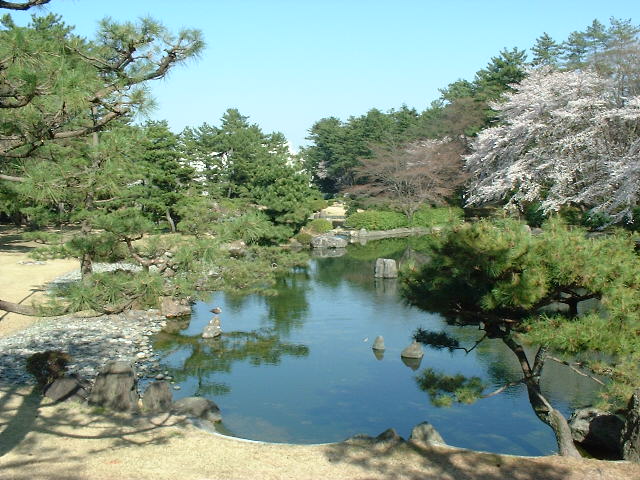
in the treatment facility at the Kawashima Plant
Data
Since FY2023, we have gradually expanded the data collection boundary, covering 21 global sites in FY2023 and all 67 global sites in FY2024.
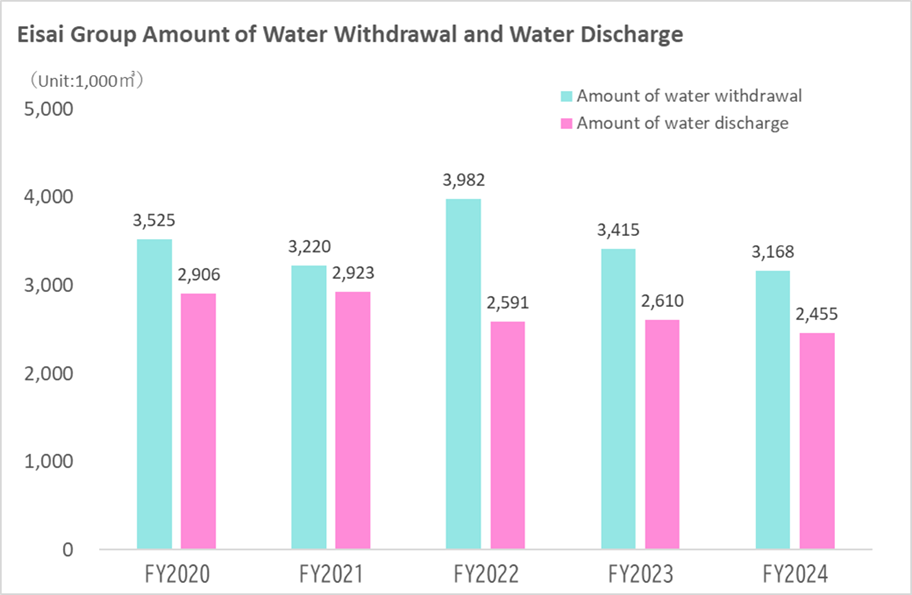
Progress toward the FY2030 water withdrawal reduction target is reflected in the FY2024 performance, with the indicator (water withdrawal [thousand m³] / revenue [100 million yen]) recorded at 0.124, which is below the FY2024 target of 0.133. The amount of water withdrawal was 3,168 thousand m³, representing an approximately 8% decrease compared to FY2023 when using the same boundary. This reduction is attributed to efforts at each site to promote efficient use of water resources, including water recycling, which helped suppress overall water consumption. In addition, the Kawashima Plant (Gifu Prefecture) constantly pumps up groundwater and discharges it to maintain the river at the request of the local government. The flow meter in the well for pumping up failed, resulting in conservative estimates in FY2023, but repairs have enabled actual measurements to be taken in FY2024.
The amount of water discharge was 2,455 thousand m³, representing an approximately 7% decrease compared to FY2023 when using the same boundary. This reduction is partly due to the Kawashima Plant, where water is stored and discharged into a pond in the on-site Japanese garden. In FY2024, the inflow of rainwater decreased, resulting in a lower volume of water discharge. Additionally, at the Bogor Plant (Indonesia), a new flow meter was installed in the sewage channel, enabling direct measurement. As a result, the recorded water discharge volume decreased.
Although business activities are expected to expand in the future, we will continue to promote the efficient use of water resources across the company.



CDP Water Security Report 2024
CDP is an international NGO that evaluates the “efforts of companies related to environmental risks” (climate change, water security, forests) and discloses the information at the request of institutional investors around the world. Since 2021, the Eisai Group has responded to the CDP Water Security Report. In the CDP Water Security Report 2025, we received a score of A (leadership level), the highest on an 8-rank scale from A, A-, etc., to D and D- for both climate change and water security.
