
Structures and Systems
Eisai is a company with a nomination committee system, whereby the Board of Directors entrust a large portion of the decision-making authority over business execution to the corporate officers in order to devote its attention to the oversight of management, while the corporate officers strive for prompt, flexible decision making and business execution.
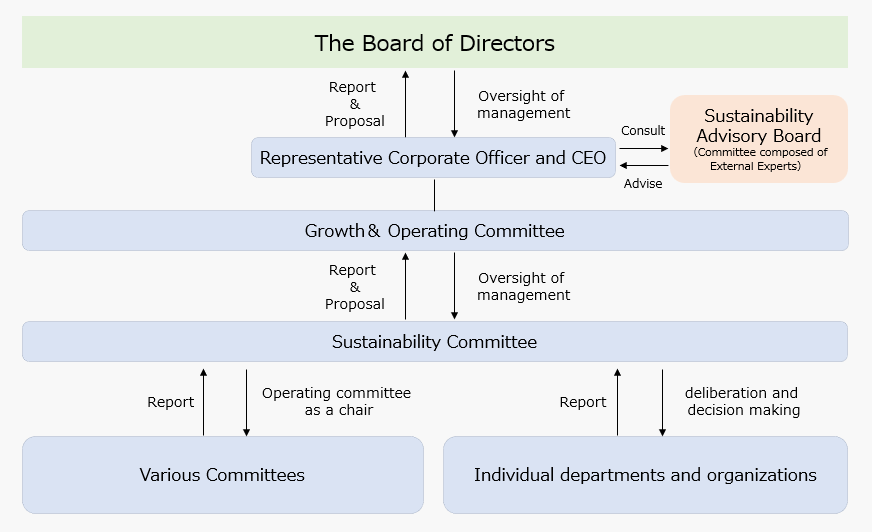
Sustainability issues, which are positioned as management challenges essential to enhancing long-term corporate value, are also addressed within this framework. Under a system with clear separation of management oversight and business execution, Eisai established the Sustainability Committee within the operational divisions, that formulates policies and strategies to contribute to a sustainable society and promotes relevant measures.
To gain broad, high-level insights on sustainability, Eisai has also established the “Sustainability Advisory Board” comprised of external experts well-versed in international policy as an advisory council to the CEO.
In addition, Eisai has established a dedicated department (the Sustainability Department) to oversee the individual sustainability issues being addressed, as well as to monitor the external environments surrounding the Company. This structure enables company-wide engagement in sustainability efforts. The Sustainability Department is also responsible for developing and implementing initiatives to improve access to medicines in the field of global health, which Eisai considers a key area of contribution.
The Sustainability Committee
Based on the understanding that social sustainability challenges are management issues essential to the enhancement of long-term corporate value, the Sustainability Committee deliberates on the planning and execution of various initiatives. The committee is co-chaired by the corporate officers in charge of company-wide business strategy and sustainability, and consists of the corporate officers in charge of human resources, general affairs, supply chain, risk compliance, etc. The committee examines ESG issues from various perspectives and implements initiatives to address them.
Under the Sustainability Committee, Eisai has established several meeting bodies, including the Company-Wide Environment and Safety Committee and the Human Rights Awareness Committee, to address matters concerning environmental and social sustainability. The Sustainability Committee also deliberates and makes decisions regarding key internal sustainability initiatives, including global HR strategy (human capital etc.), environmental conservation (climate change, pollution, natural resource, etc.), and global health.
The Sustainability Committee’s discussions are regularly reported to the Growth & Operating Committee, which in turn reports to the Board of Directors. In addition, the Sustainability Committee regularly reports on the Company’s efforts toward sustainability issues to thehhcGovernance Committee, composed solely of outside directors.
Sustainability Advisory Board
With the aim of further enhancing our initiatives for access to medicines, Eisai convened an Access to Medicines Advisory Board from 2011 to obtain advice from international policy and development experts on our strategies and initiatives to provide solutions sustainably to patients and their families. In 2018, we expanded the scope of the board to form the "Sustainability Advisory Board" to discuss topics related to Eisai’s activities on sustainability and to receive recommendations and advice from our advisors. In addition to further strengthening access to medicines, we also aim to discuss Eisai’s response to global issues highlighted in the international community, such as human rights and climate change, as well as economic security and other issues, and to translate advice from the members of Sustainability Advisory Board into enhanced our corporate value. The Sustainability Advisory Board meets annually.
Members of Sustainability Advisory Board
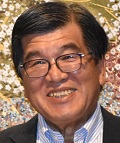
Mr. Mitsuo Sakaba (Chairman)
Former Ambassador to Vietnam | Former Ambassador to Belgium
A distinguished diplomat, Mr. Mitsuo Sakaba entered the Ministry of Foreign Affairs of Japan in 1973, after graduating from the Faculty of Literature and Science, Yokohama City University. Following language training in France, he served in India, France, Egypt, the United States, and other countries. At the Ministry’s headquarters, he held various senior positions, including Minister's Secretariat Director-General for Policy Planning and Coordination, Director-General of the Latin American and Caribbean Affairs Bureau, and Press Secretary. From 2008 to 2010, he served as Ambassador of Japan to Vietnam. In 2014, he retired from the Ministry of Foreign Affairs after completing his final post as Ambassador of Japan to Belgium and Representative of the Government of Japan to NATO. Thereafter, he served as a Specially Appointed Professor at Yokohama City University from 2015 to 2017 and as a Member of the Public Security Examination Commission under the Ministry of Justice from 2017 to 2021. He currently serves as Representative of MS International Consulting Office, Chairman of the Asian Culture Research Forum, Advisor to the Japan Forum for Strategic Studies (JFSS), and Advisor to the Association for Supervising and support Organization of Employment for Skill development (ASE). In the spring of 2024, he was awarded the Order of the Sacred Treasure, Gold and Silver Star.
His publications include Vietnam and New Perspectives on Asia: Becoming Internationally Minded Now (Shingaku Publishing, 2019) and Asian Politics and Diplomacy from a Historical Perspective (Canaria Communications, 2024), among many others.

Mr. Ujal Singh Bhatia
Former Ambassador and Permanent Representative of India to the World Trade Organization (WTO) | Former Chairman, WTO Appellate Body
Mr. Ujal Singh Bhatia serves on Eisai's Sustainability Advisory Board, bringing to that role his extensive experience in international economic policy, public health governance, and global trade law. A former Indian Ambassador to the World Trade Organization (WTO) and former Chairman of the WTO's Appellate Body, Mr. Bhatia built his career across a wide range of roles in the Indian civil service — from field administration to economic policy and international trade. In the later years of his career, he focused on trade negotiations and dispute settlement, representing India in global forums and contributing to the evolution of international trade law. He continues to adjudicate international trade disputes.
His sustained engagement with questions of sustainability, public health, and the implications of a rapidly changing global economy informs his contribution to Eisai's mission of aligning innovation with social responsibility.

Dr. BT Slingsby
Founder & Former Executive Director & CEO, GHIT Fund | Founder & Managing Director, Catalys Pacific
Dr. BT Slingsby founded the Global Health Innovative Technology (GHIT) Fund — the world's first public-private partnership dedicated to developing new medicines for neglected diseases affecting low- and middle-income countries. As CEO and Executive Director, he deployed over 100 investments in the discovery and development of new medicines for infectious and neglected tropical diseases, and grew the fund to $350 million in capital. He subsequently founded Catalys Pacific, a transpacific bioventure firm transforming life-sciences innovation between Japan and the United States. Dr. Slingsby specializes in healthcare investments spanning novel therapeutics, diagnostics, and vaccines. He has served on the National Academy of Medicine’s Forum on Public-Private Partnerships for Global Health and Safety, authored more than 50 peer-reviewed articles, and taught at the graduate schools of medicine at the University of Tokyo and Kyoto University.
Messages from Sustainability Advisory Board Members
Message from Mr. Mitsuo Sakaba (Chairman)
The United Nations General Assembly adopted the Millennium Development Goals (MDGs) in 2000, just before humanity entered the twenty-first century. Fifteen years later, a new framework, the Sustainable Development Goals (SDGs), was adopted. While the MDGs focused primarily on developing countries, the SDGs established 17 goals aimed at all people, including those in developed nations, with objectives such as eradicating poverty and reducing inequality by 2030. Among these goals, Goal 3 is dedicated to “Good Health and Well-being.” Yet with 2030 now only a few years away, there is growing concern that, rather than moving closer to achieving these goals, we may in fact be drifting further from them.
In 2006, a group of United Nations-supported organizations launched the Principles for Responsible Investment (PRI), calling primarily on institutional investors to incorporate ESG considerations, namely Environmental, Social, and Governance factors, into their decision-making processes. The principles emphasize the importance of long-term management indicators that go beyond the pursuit of short-term profits and advocate that such considerations should be integrated into investment decisions. By the 2020s, many institutional investors had endorsed these principles, and individual companies increasingly began establishing specific ESG-related targets and embedding them into their management strategies. Nevertheless, significant barriers remain to improving ESG performance. More recently, there have even been signs of a backlash, with some seeking to criticize or disregard these principles from the standpoint of short-term returns. The gap between aspiration and reality remains substantial.
In the twenty-first century, societies around the world are confronting the challenges of declining birth rates, aging populations, and the need to extend healthy life expectancy. At the same time, many developing countries are facing new health threats amid accelerating global warming, while the burden of neglected tropical diseases continues to worsen. The global geopolitical landscape has also become increasingly uncertain, raising concerns about deteriorating security conditions. In many respects, the international environment surrounding the achievement of the SDGs appears to be worsening rather than improving. Against this backdrop, the responsibilities borne by private-sector companies, particularly pharmaceutical companies, are becoming ever greater. At the same time, numerous challenges must be overcome, including global human rights issues and a wide range of concerns related to economic security. These are challenges that require us to bring together our collective wisdom.
Eisai’s corporate philosophy, embodied in its human health care (hhc) concept, aligns closely with the objectives of the SDGs and reflects the spirit of ESG by emphasizing long-term value creation and responsible corporate management. As members of the Sustainability Advisory Board (SAB), we fully support this direction and hope to provide advice that helps accelerate further progress. Our members come from diverse nationalities and bring a wide range of careers and experience. I myself have served as a diplomat in several developing countries, including India and Egypt, participated in development cooperation initiatives, and been involved in United Nations activities. While each SAB member brings an external perspective, it is precisely this position that allows us to view issues from different angles. We look forward to working together with Eisai in addressing the challenges it faces and to providing thoughtful and constructive advice with the goals of the SDGs and the principles of ESG firmly in mind.
Message from Mr. Ujal Singh Bhatia
Eisai is a research-driven global pharmaceutical company distinguished by its deep commitment to human values. Its "human health care (hhc)" philosophy places patients and their families at the centre of everything it does, while fostering relationships built on transparency and trust with communities, investors, and employees. The company measures its success not only through financial performance, but also through the meaningful social impact it creates.
Eisai's strategic direction reflects a strong global outlook and a commitment to addressing healthcare inequities. This is evident in its efforts to expand access to medicines in underserved regions, including its long-standing collaboration with global health partners to provide free treatment for lymphatic filariasis in endemic countries.
Sustainability is central to Eisai's approach, and it is on this dimension that I am privileged to contribute as a member of its Sustainability Advisory Board. The company's commitment to achieving net-zero greenhouse gas emissions by 2050, and its membership of the RE100 initiative working toward 100% renewable electricity across its operations, reflect an ambition that goes well beyond compliance — it is sustainability treated as a core organisational value.
These values are deeply embedded across Eisai's organisation and continue to guide its evolution. It is encouraging to see a company consistently align innovation with a strong sense of social responsibility, and it is a privilege to be part of that ongoing journey.
Message from Dr. BT Slingsby
The global health landscape has shifted considerably in recent years — shaped by the aftermath of the COVID-19 pandemic, changing geopolitical priorities, and tightening funding environment. While the pandemic accelerated innovation and cross-sector collaboration, it also highlighted persistent inequities in access to healthcare and essential medicines. Neglected tropical diseases (NTDs), in particular, continue to impose a disproportionate burden on low- and middle-income countries, underscoring the need for sustained focus and investment. At the same time, there is growing emphasis on building resilient health systems and ensuring that innovation translates into equitable patient outcomes globally.
Against this backdrop, Eisai has demonstrated a strong commitment to advancing global health through its work in NTDs and access to medicines. Its patient-centric philosophy —sustained over decades of partnership-driven initiatives — reflects a thoughtful and responsible approach. Eisai’s efforts to expand access to essential treatments in underserved regions, together with its collaboration across global and local stakeholders, position the company as a credible and impactful contributor in this space. Notably, the integration of access considerations into its broader business strategy signals an understanding that sustainable value creation in healthcare must align with societal needs.
Looking ahead, Eisai has an opportunity to further strengthen its leadership by deepening collaboration across the global health ecosystem. Expanding partnerships across public, private, and philanthropic sectors will be key to accelerating the development and delivery of innovative solutions. In parallel, leveraging data, digital tools, and new operating models can enhance the scalability and effectiveness of access programs. As global health challenges grow more complex, Eisai is well positioned to play a leading role in bridging innovation and access. Continued focus on these priorities will enable Eisai to contribute meaningfully to improving health outcomes and addressing inequities worldwide.