
- Global Health
- Human Resources
December 23, 2025
Mycetoma has been designated by the World Health Organization (WHO) as one of the neglected tropical diseases. Infection is thought to occur when bacteria or fungi enter through small cuts or thorn pricks. Subcutaneous lesions gradually expand and, if left untreated, can cause severe pain and disfigurement. Advanced cases may require surgical excision or even limb amputation. Many patients make a living from agriculture or livestock, so illnesses that interfere with movement or require surgical treatment can prevent them from working, and expose them to social discrimination, trapping them in a vicious cycle of poverty and disease.
As one of the countries with the highest prevalence of mycetoma, Sudan urgently needs effective treatments. Yet Sudan is facing significant difficulties due to poverty, cultural factors, and armed conflict. We interviewed Mr. Noritsugu Maki of Eisai’s Tsukuba Research Laboratories, who made significant contributions to ensure the shipment of investigational drugs to Sudan amid armed conflicts.
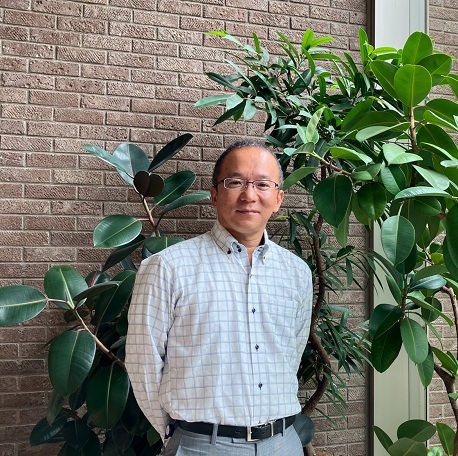
Mr. Noritsugu Maki
Planning & Coordination, Pharmaceutical Science & Technology, Tsukuba Research Laboratories
In 2014, the Eisai-discovered antifungal agent E1224 (fosravuconazole) was reported to have potent antifungal activity against the key pathogens that cause mycetoma. Since 2017, Eisai has partnered with Drugs for Neglected Diseases Initiative (DNDi) and Sudan’s Mycetoma Research Centre (MRC) to develop the drug for mycetoma. A Phase II trial was conducted in Sudan with funding from the Global Health Initiative Technology (GHIT) Fund and others, which was completed in 2022. An early-access study was planned to provide the investigational drug fosravuconazole to ensure patients’ access to the treatment until regulatory approval in Sudan. Eisai began production of the investigational drug in September 2023, and the medicine was ready for shipment by March 2024.
However, after April 2023, armed conflict erupted across wide areas of Sudan, including the capital Khartoum.
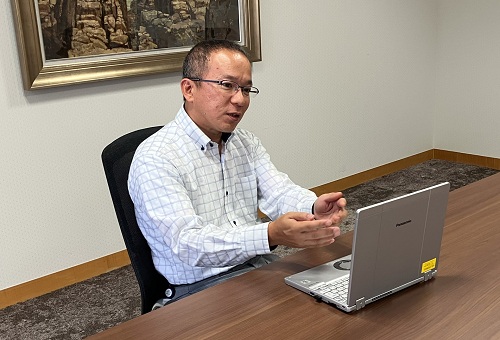
The search for shipping routes amid scarce information due to armed conflict.
Since the military conflict in April 2023, it has become difficult to obtain local information of the country. In November 2023, after confirming that Khartoum International Airport, the destination for the investigational drug, had been shut down, we started working with Mr. Yoshihiro Oguchi, who is responsible for import and export in the formulation research department of Eisai, to secure alternative logistics routes. After confirming that safe transportation would be possible via import through Port Sudan New International Airport in eastern Sudan, we proceeded to plan land transportation from Port Sudan to the MRC in Khartoum. However, at that time none of the vendors were able to provide domestic delivery within Sudan. In addition, information on the operational status of airports and other facilities in the country was unavailable. This state of uncertainty persisted for several months as we continued to navigate the situation with limited information. It was an extremely difficult situation, far beyond what we had anticipated when we first began coordinating transportation.
This was an exceptional case even for Eisai, which has expertise in logistics in many countries.
Our previous experience in transporting investigational drugs for the Phase II study in Sudan was under normal peacetime conditions and therefore was not applicable to logistics planning in a conflict environment. With the assistance of many parties, including Professor Ahmed Fahal of the MRC, DNDi, the Embassy of Japan in Sudan, Eisai staff at the Saudi Arabian sales office who speak Arabic language, and Sudanese local agents, we were able to obtain various information on the airlines serving Port Sudan and their related companies. We attempted shipping the investigational drugs from Japan via neighboring countries such as Egypt, Ethiopia, and Saudi Arabia, but we were unable to secure cargo space on flights to Port Sudan from any of those transit points. I presume that relief shipments were being prioritized, leaving no available capacity for our investigational drugs. Under such circumstances, even if shipments were sent to transit hubs, there was a risk that study drug would be held there or returned. Considering the need to ensure the quality of the investigational drug, we could not dispatch them via those routes. Although routes from Japan to Port Sudan existed, we were unable to reserve cargo space even for a single carton, leaving shipments suspended for several months.
While trying to secure transportation routes, an unexpected bottleneck emerged: the lithium-ion batteries in the temperature loggers attached to our cartons. Carriers would not accept the shipments.
We identified an airline serving Port Sudan that appeared able to provide cargo space. However, while preparing the shipment we were informed that the cargo could not be loaded on flights to Sudan because the temperature loggers contained lithium-ion batteries. Pharmaceutical products must be kept within specified temperature ranges for quality control, including during transportation. To guarantee this, temperature loggers are included in shipments. Under normal circumstances, temperature loggers that contain lithium-ion batteries are acceptable if the proper application is made, but in politically unstable conditions we came to realize that unforeseen problems could arise.
Although the early-access study was originally planned to take place at the MRC in Khartoum, the investigational site was relocated to Al Jazirah, then to Wad Onsa, and finally to Kassala in the east of Sudan to avoid conflict affected areas. Each relocation required a new filing for import application, which made it difficult to finalize transportation route within Sudan. When it seemed we had no chance to carry out the mission, a turning point came when we were able to obtain support from Médecins Sans Frontières (Doctors Without Borders), one of the founding organizations of DNDi. A flight route and cargo space to Port Sudan via Kenya were secured thanks to a logistics partner of Médecins Sans Frontières East Africa, and in April 2025 we were finally able to ship the investigational drugs from Japan. It was the fruit of all of our partners’ tremendous efforts.
Shipments of the investigational drugs were ready to go from Japan to Port Sudan. We thought that delivery to patients was imminent.
Just after we dispatched the shipment in May 2025, we received a photograph of billowing white smoke and news that Port Sudan International Airport had been bombed. We first confirmed the safety of local stakeholders, and we feared our investigational drugs had been damaged and delivery had failed. In fact, the shipment had been postponed after arriving in Kenya because no cargo space was available on the flight to Port Sudan, and thus escaped the bombing. While we confirmed the shipments were being stored properly in Kenya and considered returning them to Japan, Médecins Sans Frontières informed us that when Port Sudan International Airport reopened for humanitarian support, there was cargo space available and they were able to load our investigational drugs. The shipment was now heading to Port Sudan.
After arrival in Port Sudan was confirmed, the shipment underwent strict customs inspection because it had taken an irregular route and bore labeling as an investigational drug that differed from pharmaceutical labels. Working with local partners, we provided additional information and documents promptly, but customs clearance took about two weeks, keeping us uneasy for a while.
Land transportation of the investigational drugs was finally completed guarded by a security team.
After we were informed that customs clearance was complete, we hoped the local transport would be completed safely. The shipment was moved by road to the early-access trial site in Kassala, a 600 km journey through the desert. Although authorities required unusual measures, including a security escort, the land transport to Kassala was completed, and I was deeply moved when I saw a photograph of the trial-site staff with the investigational drugs. I was physically unable to join them, but I wished I could have shared the celebration with our local partners. After almost a year and a half since we started planning the shipment, the investigational drug at last reached the destination.
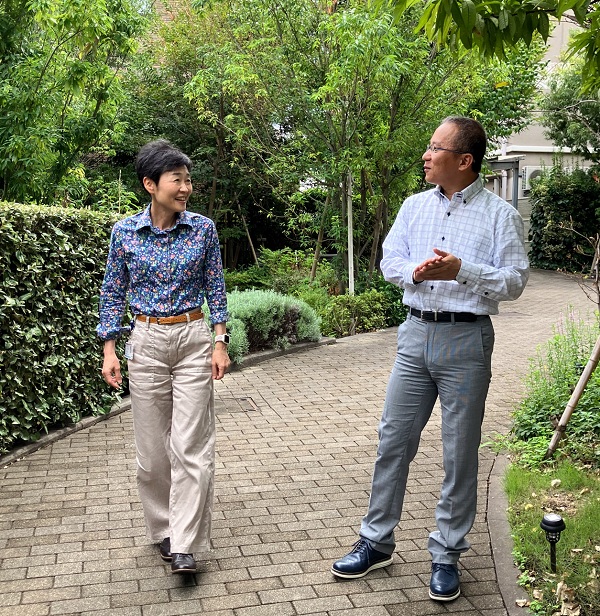
With project lead Dr. Kyoko Nakano (Sustainability Department, Eisai Co., Ltd.)
Although transport from Japan to Sudan might not become a standard procedure, the experience of various stakeholders coming together, overcoming difficulties, and ultimately delivering the investigational drugs will strengthen our future operations.
Whatever happens in the future, including conflicts, as long as patients are waiting for Eisai’s medicines, we will do everything possible to safely deliver medicines with assured quality. I am reminded again that this shipment is the product of the determination of many people who share that commitment.
Please see here for details on Eisai’s initiatives on mycetoma.
Initiatives for Mycetoma
Scientists Discuss the Development of a New Treatment for the Elimination of Mycetoma
Share


