March, 2026
Eisai’s Sustainability Department is working to improve access to medicines for Neglected Tropical Diseases (NTDs). Unlike in developed countries, delivering medicines to patients in emerging countries as well as low and middle-income countries remains a significant challenge due to various issues and obstacles, including underdeveloped healthcare infrastructure, a shortage of medical facilities and healthcare professionals, and limited access to medicines for economic reasons. Furthermore, cultural backgrounds and local customs vary by country and region, making it challenging to accurately grasp the specific issues and needs to ensure access to medicines.
Eisai is collaborating with global partners to develop treatments for an NTD called mycetoma, which is endemic in various countries including Senegal. As part of these initiatives, our Sustainability Department had an opportunity to speak with Ms. Miyuki Oikawa1, Technical Advisor, Cabinet of the Ministry of Health and Public Hygiene (former Ministry of Health and Public Hygiene), the Republic of Senegal in November 2025 as socialization for an hhc activity2. This exchange aimed to provide insights into the current environment surrounding patients and the state of healthcare infrastructure as well as a better understanding of specific challenges and needs in Senegal.
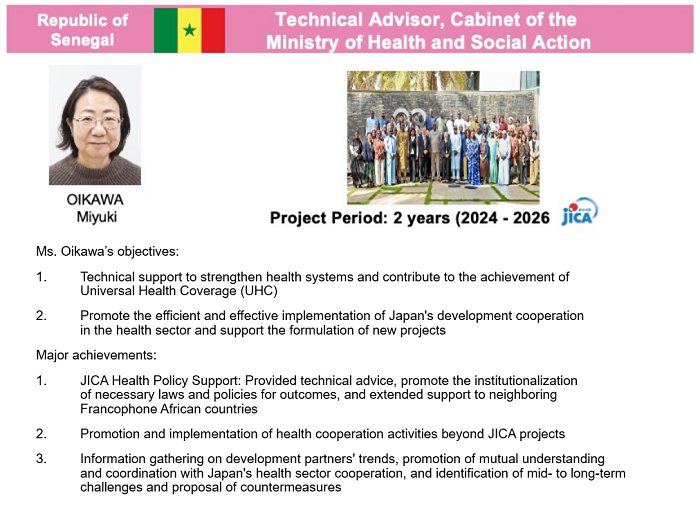
Ms. Oikawa is a member of the Bureau of Global Health Cooperation, the Japan Institute for Health Security (JIHS). Since May 2024, she has been dispatched by the Japan International Cooperation Agency (JICA) as a Technical Advisor to the Cabinet of the Ministry of Health and Public Hygiene of the Republic of Senegal. In this role, she provides strategic advice for health sector projects implemented by JICA, supports the execution of policies for the Ministry of Health and Public Hygiene of Senegal, and offers guidance to Japanese corporations and universities active in Senegal’s healthcare sector.
Health and Hygiene Conditions in Senegal: Access to toilets and clean drinking water remains a challenge in some regions
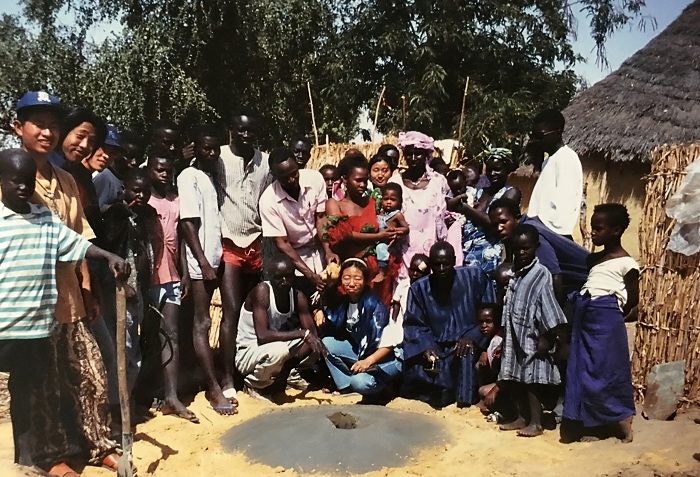
Ms. Oikawa is in the center
Ms. Oikawa has worked in several West African countries and visited local health facilities. This photo was taken 30 years ago, while she was participating in JICA’s volunteer activities. Both then and now, Senegal’s primary care facilities, which are public healthcare institutions most accessible to residents, have no doctors, leaving nurses and midwives to serve as the facility heads. While she was interacting with residents and working with staff from the Ministry of Health, Ms. Oikawa worked towards improving access to toilets, a public health issue. Referring to ideas from a book by David Werner3, which contains ideas on maintaining basic health standards in the absence of doctors, she created a prototype toilet and invited residents to test it. Following a cholera outbreak in other villages, she eventually collaborated with the Ministry officials and locals to construct nearly 60 toilets.
Even today, some areas continue to face challenges in both toilet access and securing clean drinking water. For instance, according to a 2019 report4, only 45% of schools have basic drinking water facilities, and a mere 16% are equipped with sanitation systems, including toilets. As significant regional and economic disparities still persist in Senegal, achieving universal access to these facilities may take more time.
There also remain challenges in gender related matters. According to a report from the Kaffrine Region, only 21% of schoolgirls practice recommended menstrual hygiene habits, and 45% miss classes during their periods. The high cost of menstrual products, a lack of gender-separated toilets, and insufficient knowledge regarding menstrual hygiene are possible reasons for this issue. With nearly half of all schoolgirls miss school every month due to their periods, this situation deprives them of educational opportunities.
Healthcare Challenges: Lack of Funding and Information, as well as Vulnerable Infrastructure
Malaria, HIV/AIDS, tuberculosis, hepatitis, and NTDs are explicitly designated in infectious disease control strategies of Senegal’s Plan National de Développement Sanitaire et Social (2019-2028)5. Although the three major infectious diseases (malaria, tuberculosis, and HIV/AIDS) receive funding from the Global Fund, NTDs face a more difficult situation. Despite having budget plans in place, a lack of development partners and insufficient funding make it extremely challenging to deliver these plans into action. Moreover, a lack of detailed information regarding each specific NTD remains a significant challenge.
The country’s underdeveloped medical infrastructure also presents issues, such as insufficient division of roles and coordination between traditional and Western medicine. In some cases, patients with diseases like cancer, for which Western medicine has more clearly established outcomes, solely rely on traditional treatments leading to aggravated symptoms. In some cases, patients choose traditional treatments because they find them more familiar and easier to consult with than Western medicine.
Future Outlook: Addressing Development Challenges Beyond the Healthcare Sector
Ms. Oikawa provided insight into Senegal’s social security and health systems, the pharmaceutical supply chain, and government policies, leading to active discussions among the team members. Key factors affecting health in Senegal include lifestyle, sanitary conditions, and healthcare systems. While life expectancy in Senegal is expanding and the population is expected to grow, the healthcare supply is lagging behind demands. As a result, the country continues to face a shortage of medical facilities and healthcare professionals. Senegal has designated UHC (Universal Health Coverage), a key target of the United Nation (UN) Sustainable Development Goals, as one of their policy priorities, aiming to ensure that all people can access the basic health services they need at a price they can afford. However, achieving UHC is a major national challenge that requires the involvement of various sectors beyond just healthcare.
Through this session, the Sustainability Department team members gained deeper insight into the situation in Senegal, a country far away from Japan, and the environment surrounding daily lives of patients there. Amid the difficulties and challenges that exist beyond what our Japan-based team initially expected, this session served as a vital opportunity to reflect on the need for continuous collaboration with various stakeholders, and highlighted that multidimensional discussions are essential to truly drive initiatives for improving access to medicines. The Sustainability Department team will leverage these insights to enhance our initiatives toward the improvement of access to medicines.
Eisai will continue to support patients and the people in the daily living domain to live their fullest lives. To achieve this, we strive to promote understanding of the global health through the recognition of local situations, coordination with stakeholders, and collaborative thinking.
Share


